Use this cubic equation calculator to solve third degree equations quickly and accurately. Enter coefficients to find real or complex roots instantly with a simple cubic solver.
This cubic equation calculator lets you solve cubic equations fast by entering the coefficients in standard form. Get instant results for real or complex roots with a clear output that works well for study, practice, or quick answer checking.
How to Use the Cubic Equation Calculator
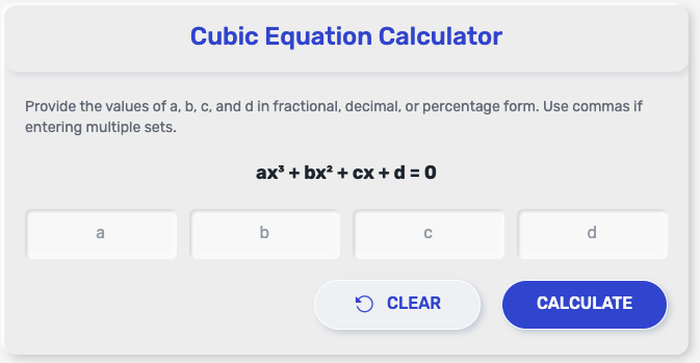
Using the cubic equation calculator is simple. You only need the four coefficients from your equation in standard form. After that, the tool gives the roots in just a moment.
Enter the values of a, b, c, and d
Make sure the equation follows ax³ + bx² + cx + d = 0
Use 0 for any missing term
Click the Calculate button
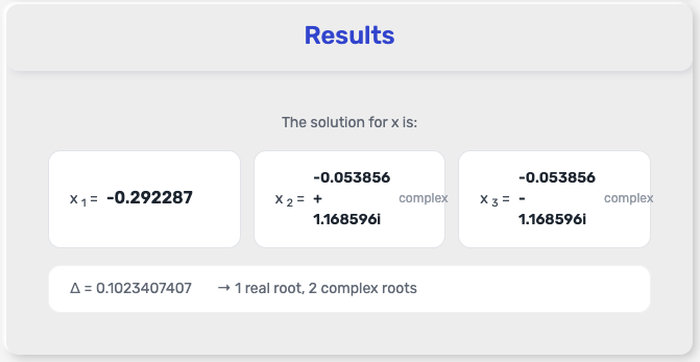
View the roots of the cubic equation in the result box
This cubic solver is useful when you want a quick answer, check your work, or solve a third degree equation without doing every step by hand.
What This Cubic Equation Solver Can Calculate
This cubic equation calculator is built to handle a wide range of third degree equations. Whether you’re working with simple numbers or more complex inputs, the tool processes everything in one step and returns complete solutions.
Solve standard cubic equations in the form ax³ + bx² + cx + d = 0
Find all roots of the equation, including real and complex solutions
Handle cases with one real root or three real roots
Work with both integer and decimal coefficients
Return results in decimal or simplified form depending on input
Explanation of Results from the Cubic Equation Calculator
After you enter the coefficients and run the calculation, the tool returns all solutions of the cubic equation based on your input values. Each result represents a value of x that satisfies the equation.
The output may include:
One real root and two complex roots
Three real roots
Repeated roots (when two or more solutions are the same)
Complex roots are shown in the form a + bi, where i represents the imaginary unit.
The results are typically displayed in decimal form. Depending on the calculator settings, values may be rounded slightly for readability.
You can use these results for solving math problems, checking answers, graphing cubic functions, or applying them in technical calculations where polynomial equations are involved.
Common Use Cases for a Cubic Equation Solver
People often use a cubic equation solver when they need a quick and reliable way to find the roots of a third degree equation. It is useful in both classroom work and practical problem-solving where doing the full process by hand would take more time.
Solve algebra and polynomial practice problems
Check answers after solving a cubic equation manually
Work with graphing questions involving cubic functions
Find roots for homework, quizzes, or exam preparation
Use in engineering, physics, or technical calculations that involve third degree equations
Cubic Equation Formula
The cubic equation calculator works based on the standard form of a third degree equation:
ax³ + bx² + cx + d = 0
This is the format you need to enter into the cubic solver so it can correctly calculate all roots of the equation.
When Does a Cubic Equation Have 1 or 3 Real Roots?
Not every cubic equation gives the same type of result. Some return a single real solution, while others return three. This difference comes from a value called the discriminant, which reflects how the graph interacts with the x-axis.
General form of a cubic equation: ax³ + bx² + cx + d = 0
Δ = 0 → the equation has repeated roots (at least two are equal)
Δ < 0 → the equation has 1 real root and 2 complex roots
How this connects to the calculator result
If you see three different real values, the discriminant is positive
If some results look identical, the equation has repeated roots
If complex numbers appear, the discriminant is negative
Cardano’s Formula for Solving Cubic Equations
Some cubic equations are easy to factor, but many are not. In those cases, a more advanced method is used behind the scenes in a cubic equation calculator — Cardano’s formula.
Step 1: Convert to a simpler form
Start with the general equation: ax³ + bx² + cx + d = 0
Then apply a substitution: x = t − b/(3a)
This removes the squared term and gives a simpler equation: t³ + pt + q = 0
Cardano’s formula works by breaking a complex cubic equation into smaller, more manageable parts. Instead of relying on trial-and-error or guessing possible roots, it uses cube roots to directly construct the solution.
This approach allows the equation to be solved even when factoring is not possible, which is why it is commonly used in many cubic equation calculators to produce exact or highly accurate results.
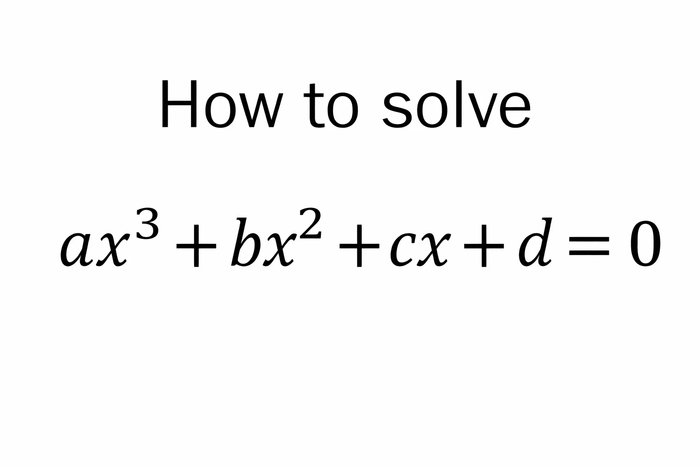
👉 If you want to see how this formula is applied step by step, this video gives a clear visual walkthrough:
Depressed Cubic Transformation
Some cubic equations look complicated because of the squared term. A common technique is to rewrite the equation into a simpler form called a depressed cubic, where the x² term is removed.Starting equation
ax³ + bx² + cx + d = 0
To eliminate the squared term, use: x = t − b/(3a)
After substitution, the equation becomes: t³ + pt + q = 0
This is called a depressed cubic because it no longer contains the t² term.
How it connects to the calculator
Many cubic equation calculators apply this step automatically
You don’t see it, but it simplifies the solving process internally
It improves both speed and accuracy of the result
Tips for Getting Accurate Results
To get correct results from the cubic equation calculator, it’s important to enter your values carefully. Small input errors can lead to completely different roots, so a quick check before calculating can save time.
Always enter the correct coefficients
Include 0 for missing terms (e.g., no x² term → b = 0)
Double-check signs (+ / −)
Keep inputs consistent if working with applied problems
Common Input Mistakes to Avoid
Some common mistakes can cause incorrect results or confusion when using a cubic solver. These are easy to fix once you know what to look for.
Forgetting to set the equation equal to zero
Skipping coefficients
Mixing variables or formats
Entering the full equation instead of separate coefficients.
Weisstein, E.W. – Cubic Formula https://mathworld.wolfram.com/CubicFormula.html
Encyclopaedia Britannica – Cubic Equation https://www.britannica.com/science/cubic-equation
Encyclopaedia Britannica – Cardano and the Solving of Cubic and Quartic Equations https://www.britannica.com/science/algebra/Cardano-and-the-solving-of-cubic-and-quartic-equations
FAQ
Can this cubic solver find complex roots?
Yes. If the equation does not have three real roots, the cubic solver can return one real root and two complex roots.
Why does the calculator sometimes show three answers?
A cubic equation can have up to three roots. Depending on the equation, those may be three real roots or one real root with two complex roots.
What happens if the first coefficient is 0?
If a = 0, the equation is no longer cubic. In that case, it becomes a quadratic equation or a lower-degree equation.
Can I use decimals in a third degree equation calculator?
Yes. Most cubic equation calculator tools accept decimal coefficients as well as whole numbers.
About us
Solving cubic equations can quickly become complex without the right approach. cubicequationcalculator.com was developed to break down that complexity—giving users a fast and reliable way to find roots and understand equation behavior without getting lost in lengthy manual calculations. Whether you're studying algebra, working through advanced math problems, or verifying results, this tool is built to support clarity and precision.
This tool is the result of collaboration within the cubicequationcalculator.com team, with contributions from developers, math-focused specialists, and technical writers dedicated to turning complex mathematical processes into accessible digital tools.
Policy
Complex math tools should still feel clear, dependable, and easy to use.
Privacy
cubicequationcalculator.com does not ask for personal information or require registration. Any equation values you enter are used only to generate results and are not stored or shared.
Accuracy
This tool is designed to provide reliable cubic equation calculations based on the input provided. Still, users should review results carefully when using them for coursework, research, engineering tasks, or any situation where precision is especially important.
Intended Use
The calculator is meant to support learning, problem-solving, and quick verification. It is a helpful reference tool, but it should not replace full mathematical review or professional judgment in technical applications.
Policy Updates
We may revise this Policy from time to time as the tool is improved or updated. Any changes will be posted here to keep the information clear and current.